

News For and About the
Disabled Community
____________________________________________________________________
Visit www.lifelabs.ucp.org, a technology and grassroots-focused initiative of United Cerebral Palsy dedicated to identifying, developing, and supporting ideas that will make a difference in the lives of people with disabilities. Through dynamic collaborations with individuals, businesses, and communities, we help bring innovative ideas to life.
Spotlight on Supported Living Services
View our Supported Living services spot airing on WDSU-TV, New Orleans. We provide a broad range of services for adults with developmental disabilities. Click here to find out more or call us at (504) 461-4266, extension 222.
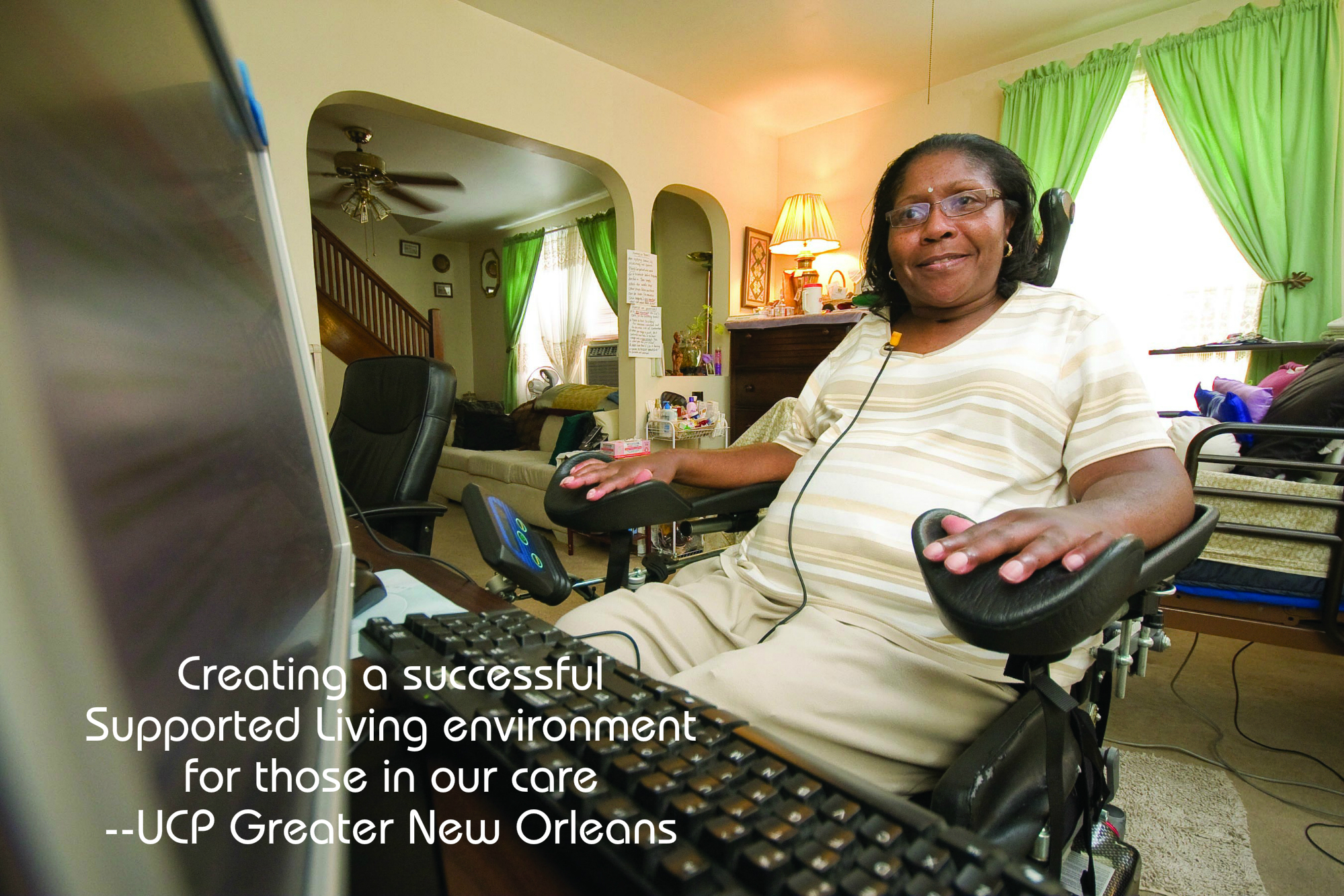
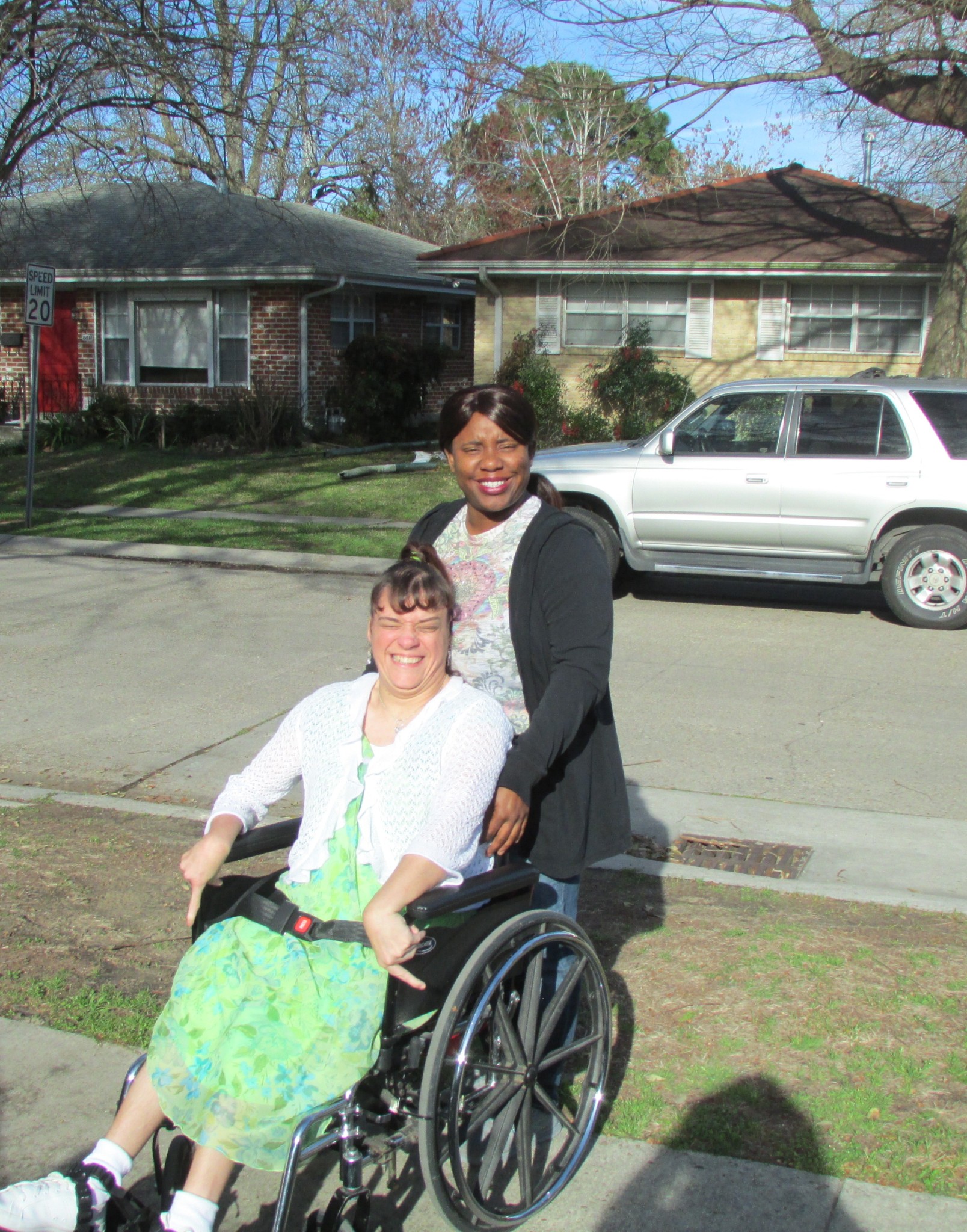
Many individuals, even those with severe disabilities, are able to live in their own homes and become active members of the community because of UCPGNO’s Supported Living Services Program. We provide a broad range of services for adults with developmental disabilities. One-on-one direct services are provided to ensure that our participants are successful in their daily living activities.
Our specially trained staff members assist individuals with their personal needs including but not limited to daily life skills training, housing, money management, transportation, socialization and recreation.
Nationwide, more than one million individuals with disabilities rely on the services of Direct Support Professionals to live, work and thrive in their communities.
For more information on our Supported Living Services, contact us at (504) 461-4266.
Has Special Education Changed in New Orleans?
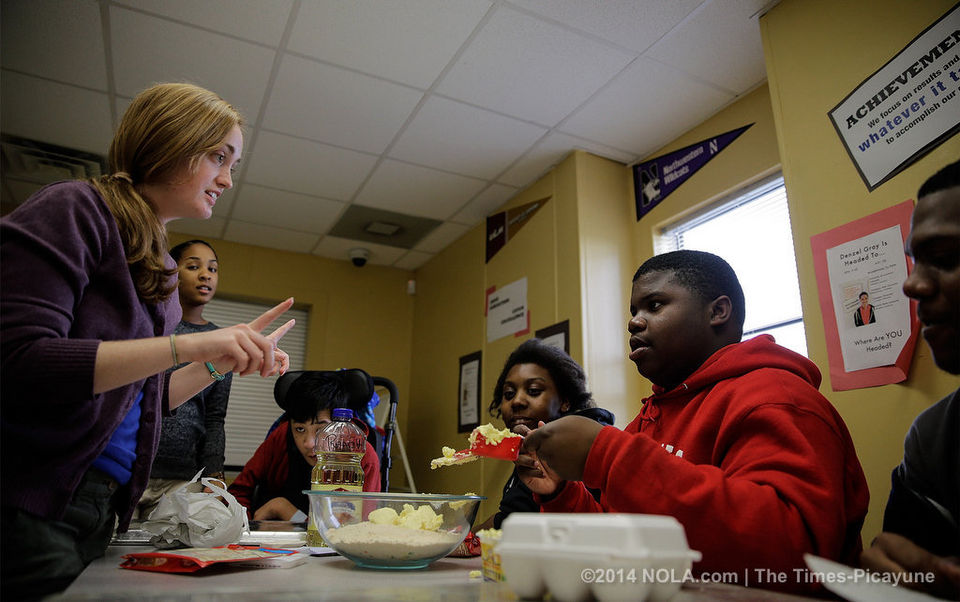
Five years ago, special education was so lacking in New Orleans’ dual public school systems that the Southern Poverty Law Center sued, charging more than 4,000 children each year were being irreparably harmed. But as the 2014-15 academic year closes, a consent agreement is going into place, and both the plaintiffs and the defendants are optimistic that improvements are coming.
Read this six part series on Special Education and find out how new money, oversight and school options can make a huge difference in students’ lives.
3 Challenges Facing Parents of Teens With Learning Disabilities
Louisiana Has One of the Highest High School Dropout Rates for Students with Learning Disabilities
School hasn’t been easy for one Colorado teenager with severe dyslexia.
“You can see a little bit of the pain that it’s caused him over the years,” says Lissa True, as she reflects on her 18-year-old son Anthony’s upcoming high school graduation. “He’s got a few scars, but the bigger emotion is just being incredibly proud of his accomplishment and looking forward to the future and to life where he is going to be exceptionally successful, even though in school some people may look at him and say he wasn’t as successful. Not an honor roll student, but you know what, that’s OK with us.”
Her son will be studying diesel mechanics at a trade school following graduation.
The graduation rate for students with learning disabilities is much lower than the national average, according to a 2014 report from the National Center for Learning Disabilities. Louisiana, Nevada and South Carolina are the only states with higher dropout than graduation rates for these students.
The report defines learning disabilities as differences in the brain that affect how someone learns, understands or communicates information. Common learning disabilities include dyslexia, which has to do with reading, and dyscalculia, which deals with math. Attention deficit hyperactivity disorder, known as ADHD, is not a learning disability, but a related condition.
Below are some of the challenges parents face when dealing with their teenager’s learning disabilities.
- Raising teens with growing independence: Teens with learning disabilities are just like those without these issues. “They want the independence and they deserve it and they should have it,” says True, who also has a daughter, Victoria, 15, who is mildly dyslexic.
“As a parent, we have to have the wisdom to be able to step back and give that to them, while still just gently guiding them into the things that they need to do,” she says.
“I think most of the responsibility on parents is to make sure that they have the tools and the skills that they need to be able to manage themselves,” she says.
That has included helping her children become advocates for themselves at school to make sure they get the accommodations they need to be successful, she says.
- Trying to help teens when they aren’t eager for help: Sometimes high schoolers stop asking for or resist using supports, like working with a special education teacher in a separate setting, that may make them stand out, says Bob Cunningham, an education adviser for Understood.org, an online parenting resource for learning and attention issues.
“That can be really, really frustrating for parents who have spent so much time working with schools and working with independent practitioners to get those kind of supports in place for a child with a learning disability,” he says.
This could lead to poorer academic performance, which could cause students to feel bad about themselves, he says.
Students whose learning issues don’t surface until high school may not be eager to participate in evaluations and work with specialists, he says.
When they are younger, students who are bright and have good speaking skills may be able to hide any learning struggles more easily, he says.
- Helping plan for a teen’s life after high school: During the high school years, the biggest challenge for Georgia mom Laurie Smith has been preparing for her children’s transition to adulthood.
Her two children – recent college graduate Amanda, 23, and Ryan, 18, who will be starting college in the fall – have learning disabilities. For them, pursuing a college degree was the end goal, she says. The challenge in high school was to figure out what supports and services would work for them then and long term. Like True in Colorado, Smith has encouraged her children to advocate for themselves.
“I can’t go to college with them,” she says. “They have to be able to use their voice effectively to say, ‘Hey, I’m an individual with a learning disability and here are the things that I need to be successful.’ That takes time for children to learn those skills, but also just to get comfortable with it.”
— www.usnews.com
Many individuals, even those with severe disabilities, are able to live in their own homes and become active members of the community because of UCPGNO’s Supported Living Services Program. We provide a broad range of services for adults with developmental disabilities. One-on-one direct services are provided to ensure that our participants are successful in their daily living activities.Our specially trained staff members assist individuals with their personal needs including but not limited to daily life skills training, housing, money management, transportation, socialization and recreation.Nationwide, more than one million individuals with disabilities rely on the services of Direct Support Professionals to live, work and thrive in their communities.
For more information on our Supported Living Services, contact us at (504) 461-4266.
Visitwww.lifelabs.ucp.org, a technology and grassroots-focused initiative of United Cerebral Palsydedicated to identifying, developing, and supporting ideas that will make a difference in the lives of people with disabilities. Through dynamic collaborations with individuals, businesses, and communities, we help bring innovative ideas to life.
- Do you know of a child in the Greater New Orleansarea who is unable to ride a regular tricycle or bike because of a disability?
-
-
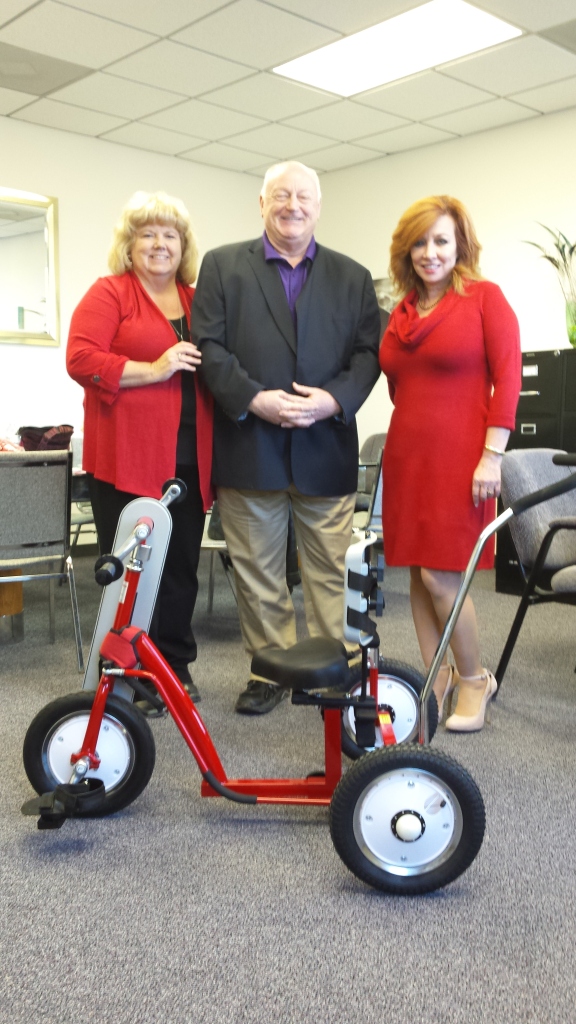
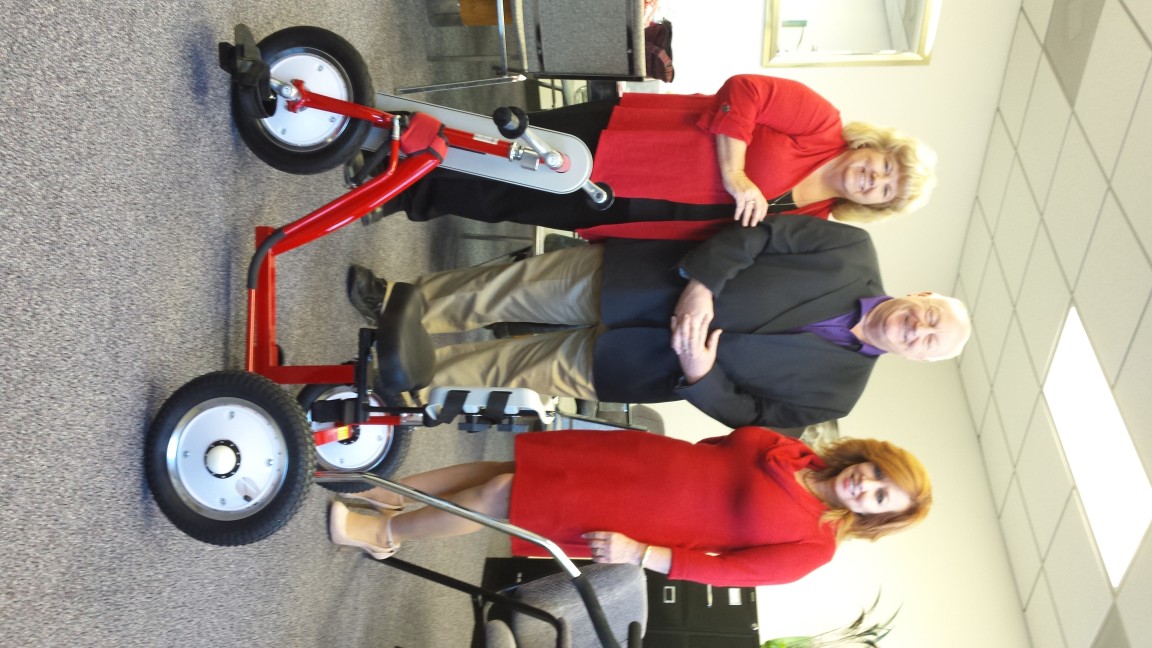
Admiring a child’s trike that can be hand or foot operated are, from left to right: NOLA AMBUCS President Cindy Payton; NOLA AMBUCS Chairman of the Board Glenn Payton, and United Cerebral Palsy of New Orleans Interim Executive Director Kendra Nelson. The New Orleans Chapter of AMBUCS provides therapeutic tricycles to children with disabilities unable to ride traditional bikes. Read more about this initiative. — Photo Credit: Alex Gonzalez

- Art is in bloom at UCP Greater New Orleans! We’ve partnered with Art a la Carte to provide holiday art classes for the disabled during December. There’s a creative spirit in all of us; Art a la Carte provides people with disabilities an artistic means of self-expression, while improving communication skills, mobility, and indepen-dence. (The artwork shown here is from an art class held several years ago at our offices.)
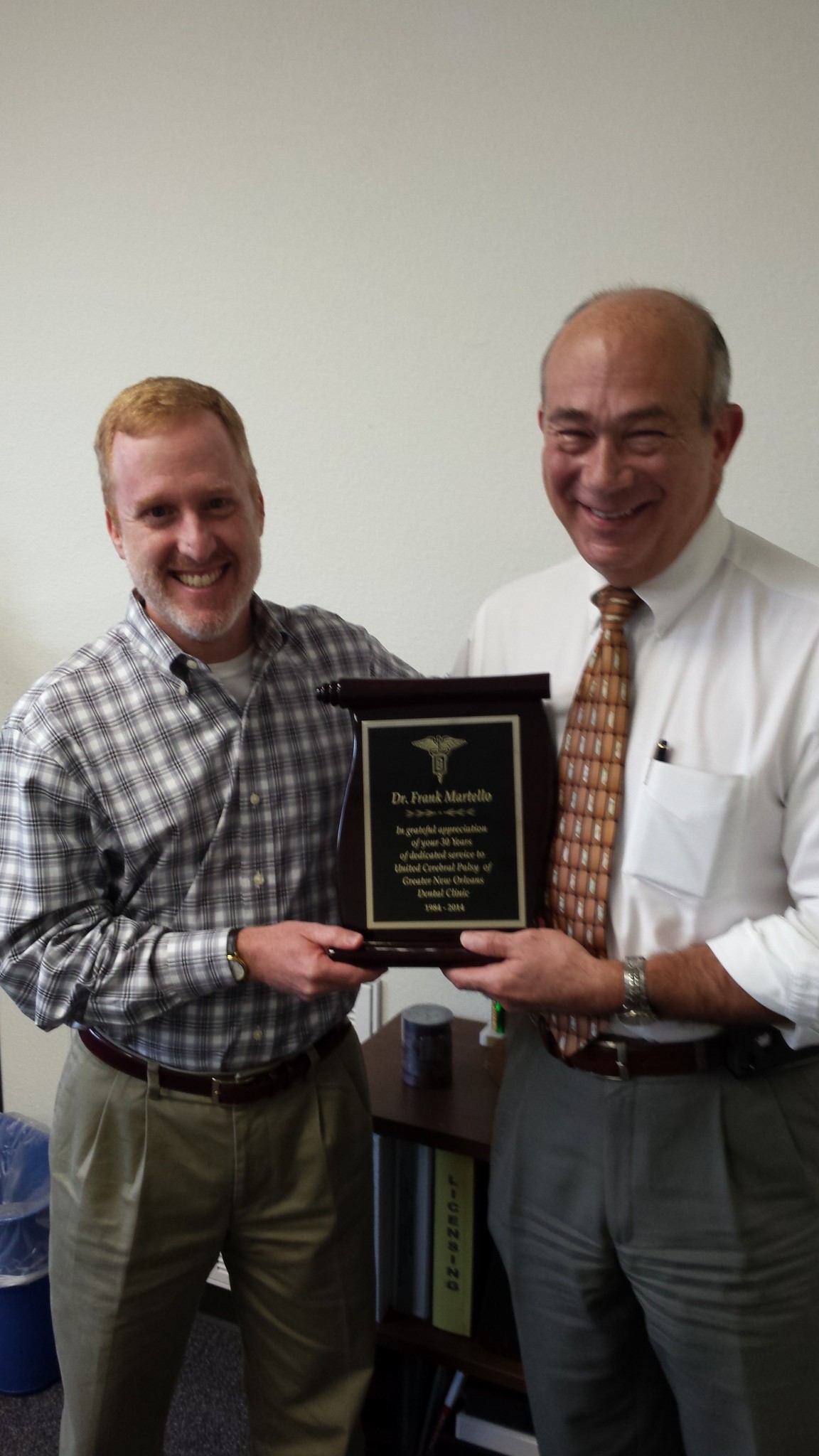
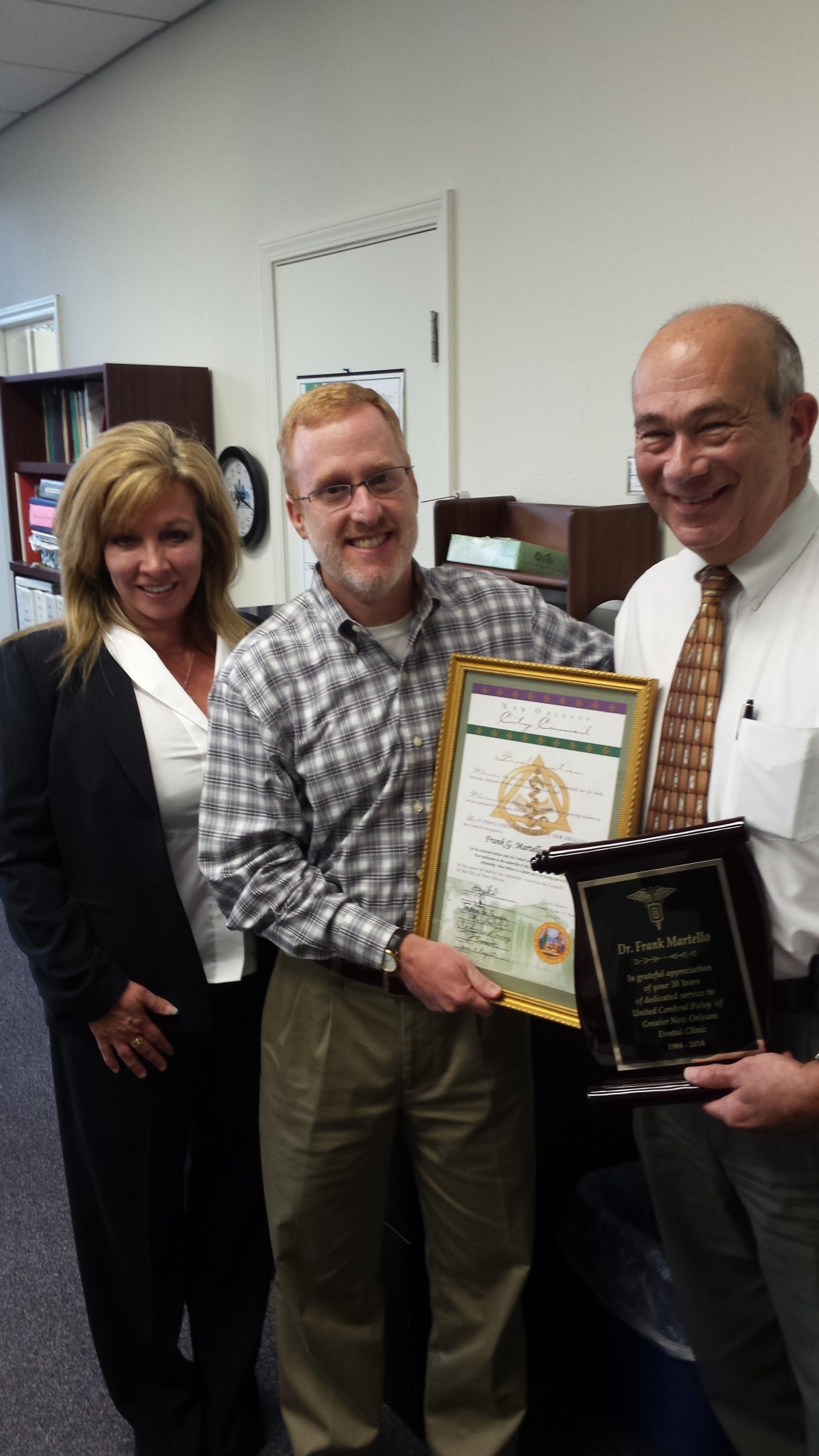
 UCP Greater New Orleans Board Chairman Steven Bain congratulates Dr. Frank Martello on his 30th anniversary as director our Dental Clinic. The free dental clinic still relies on donations to keep equipment up to date and for outreach efforts in the community. — Photo Credit: Alex Gonzalez
Read more about Dr. Martello and our dental clinic in the New Orleans Advocate.


Children with disabilities sought for free custom-bike program
Byon December 15, 2014 at 7:38 AM
Cindy Payton and husband, Glenn, serve as chairman of the board of NOLA AMBUCS, a new nonprofit organization that is compiling a “Wish List” of special needs children who cannot ride traditional bikes.
In partnership with the United Cerebral Palsy of Greater New Orleans, children with cerebral palsy, Down syndrome, spina bifida, autism and similar disabilities are identified as youth who would benefit from these custom-designed tricycles.
Through donations and fundraisers, NOLA AMBUCS purchases the trikes that operate as foot and hand cycles, including a combination of hand/foot powered cycles. This allows children with disabilities to move around independently, while improving their motor skills, endurance and strength.
Families interested in a customized trike for their child should email Cindy Payton at nolaambucs@gmail.com or call UCPGNO at 504.461.4266.
Find Accessible Playgrounds In
New Orleans and Throughout Louisiana
Did you know how there is a webpage dedicated for finding local Accessible Playgrounds? Simply enter your zip code for a list of accessible playgrounds… and Voila! A check for zip code 70118 in New Orleans shows Palmer Park featuring smooth surfaces throughout and Daneel Playspot with smooth surfaces, a safety fence and sound-play components. Check it out!
http://www.playgroundsforeveryone.com/
Dentist devotes career to helping others
By Jane Pic Adams New Orleans Advocate September 10, 2014
Oral hygiene is probably one of the most neglected aspects of the health and wellness in children and adults with disabilities. Dr. Frank Martello realized this as he was beginning his dental practice and has devoted the majority of his 35-year dental career helping others.
In 1984, realizing the needs involved in treating their often complex dental issues, Martello began volunteering at the United Cerebral Palsy of Greater New Orleans Dental Clinic at Touro Infirmary. There, children and adults with developmental disabilities, cerebral palsy, Down syndrome and autism receive the proper diagnosis and treatments.
The UCPGNO clinic was founded 50 years ago and is the oldest free dental clinic of its kind in the United States.
Martello served as the director of the clinic since his involvement began. He has also served on the UCPGNO Medical Advisory Board and Board of Directors for the past 20 years.
The clinic, now located at the UCP headquarters in Kenner, was originally funded in part by the Farhad Grotto, of New Orleans, and still relies on donations to keep its equipment up to date and for outreach efforts.
Martello’s volunteerism did not stop with UCP. He has provided oral screenings for the Louisiana Special Olympics at events in New Orleans and Hammond for more than 20 years. In 1988, he was instrumental in the establishment of the dental facilities for the Farhad Grotto Dentistry for the Handicapped in Harahan and volunteered there. A specific building was erected for this purpose when the Grotto moved its organization to the Harahan site.
The UCP Board of Directors recently surprised Martello by honoring him at its meeting. He was presented with a plaque and a proclamation honoring his 30 years of volunteerism with the UCP clinic and board.
“In our community, Dr. Martello has made a significant difference in the daily lives of the thousands of developmentally disabled patients he has treated over the past 30 years,” said Kendra Nelson, interim executive director of UCPGNO.
He also received a proclamation from the New Orleans City Council.
Martello is an active and involved member of the New Orleans Dental Association, serving on several committees and in officer positions on the Board of Governors, including a term as president in 1993. He is a past recipient of the Distinguished Service Award from the Louisiana Dental Association and the 2013 Honor Dentist Award from NODA.
Volunteer dentists still staff the UCP dental clinic, and although the Farhad Grotto clinic has recently closed, Martello’s vision remains strong. For information about the clinic, call (504) 461-4266.
Jane Pic Adams writes about issues of interest to individuals with disabilities and their families. Contact her at jpa.article@gmail.com.
Dentist to the Disabled: Dr. Frank Martello Honored for 30 Years of Service as Volunteer Dentist for the Developmentally Disabled of Greater New Orleans
August 18, 2014
Dr. Francis G. “Frank” Martello was honored by the Board of Directors of United Cerebral Palsy of Greater New Orleans (UCPGNO) for his 30 years of service as volunteer Director of the UCPGNO free Dental Clinic.
Oral hygiene is one of the most neglected aspects of health and wellness in the developmentally disabled. Since 1984, Dr. Martello has treated the often complex dental needs of thousands of developmentally disabled children and adults with Cerebral Palsy, Down Syndrome and Autism. The UCPGNO Dental Clinic was founded 50 years ago and is the oldest free dental clinic of its kind in the United States.
His special talents for working with the disabled as a volunteer dentist have been critically important to their health and well being, said Kendra Nelson, interim executive director of UCPGNO. “In our community, Dr. Martello has made a significant difference in the daily lives of the thousands of developmentally disabled patients he has treated over the past 30 years.”
Dr. Martello’s leadership and dedication in the area of dentistry for the disabled has enabled those who cannot afford dental care to smile with confidence again, chew food, live free from constant pain and speak properly, noted Nelson.
As a volunteer for the Louisiana Special Olympics, Dr. Martello has provided oral screenings at their events for the past 20 years, ensuring that outreach to the disabled community is his highest priority. His leadership efforts also facilitated the establishment of the Farhad Grotto Dentistry for the Handicapped facility in Harahan.
SDR: Life-Changing Surgery for Cerebral Palsy
My entire life I sat on the sidelines at social events — parties, proms, weddings — because I have cerebral palsy. While I usually never let CP stop me from doing anything, it stopped me from dancing. I was too self-conscious, too stiff, too unsure of how I would move. Falling was my greatest fear.
It was at the age of three that shoes became my symbol of hope. I slipped my hands through shoes — belonging to my parents or 10 older siblings — and crawled throughout the house on my hands and knees. I didn’t give up, paved my own path and figured out a way to walk. This taught me an important lesson that shaped the rest of my life: Anything is possible with determination and a positive attitude.
An orthopedic surgeon lengthened my Achilles tendons when I was four and a half years old. After walking in other people’s shoes during the primary years of my life, I finally learned to walk on my own two feet. As I grew older, I realized how having cerebral palsy made me different from everyone else. I couldn’t go up and down stairs without assistance. I couldn’t ride a bike. I couldn’t play sports. I was bullied at school and stared at in public.
As an adult, I began to experience more problems associated with CP. My back hurt, and I tired easily when walking. Throughout adolescence and into adulthood, doctors never told me about some of the well-known treatments such as Baclofen and Botox. They also never suggested the benefits of physical therapy — which I discovered on my own — at age 33. Two years later, I couldn’t step up curbs with my right leg. This continued to be such a problem that I asked my orthopedist for a cane. I couldn’t bring myself to use it. Instead, I avoided curbs and got a handicapped license plate. I struggled for four more years. I didn’t know there was a surgery that could help me.
Selective dorsal rhizotomy (SDR) is the only surgical procedure that can permanently remove spasticity (abnormal muscle tightness) caused by cerebral palsy. SDR is often misunderstood and scrutinized, however, it has a 100-year-old history. Why didn’t doctors tell me about this life-changing surgery? I found out about it by accident — thanks to Facebook — and there are thousands like me around the world who never would have known about SDR without the internet or word of mouth. This is unacceptable. The cerebral palsy community deserves much better.
At nearly 40 years old, I had SDR with Dr. T.S. Park, a world-renowned neurosurgeon at St. Louis Children’s Hospital, acclaimed for the minimally invasive technique he’s used on more than 2,800 patients worldwide. Dr. Park predicted SDR would allow me to move with greater ease, walk with less effort and check off the number one goal on my post-SDR bucket list: ride a two-wheel bike.
It’s been over a year since I had SDR. The spasticity in my legs is gone! I walk much smoother and straighter (no more bent knees) with heel-toe motion (instead of striking the floor with my toes first), no longer leaning to one side, and both legs are even, eliminating the need for ugly shoe inserts. I tried rock climbing for the first time, began ballroom dancing again and attended iCan Bike camp — on my 41st birthday — to learn how to ride a bike!
My SDR journey has been amazing. It is teaching me to stop believing in limits and focus on possibilities. SDR made things most people take for granted easier for me. SDR made some things achievable. Now, I can walk up and down stairs without help. Although each case is different, I am living proof of what SDR can do. I advocate and raise awareness for SDR because it changes lives. I want everyone with cerebral palsy to have the opportunity to get new legs like I did. If they get the chance to sit it out or dance, I hope they dance!
There is no cure for cerebral palsy. Selective dorsal rhizotomy is the only provenprocedure that can remove spasticity caused by CP. SDR provides a better quality of life to adults and children who qualify for it. People with CP should not have to sit on the sidelines of life and we shouldn’t have to stumble upon this life-changing surgery. SDR needs to be recognized as a successful treatment for cerebral palsy — and, most importantly — the medical community must rise to its responsibility to share SDR with doctors and patients.
Tombstone That Dad Designed For Son Who Had Disabilities Captures Boy’s Tenacious Spirit
When Ernest and Anneke Robison’s son died, they wanted his final resting place to represent what his trying yet inspiring life embodied — hope.
Matthew developed a number of disabilities when he was born in 1988 due to a lack of oxygen. He was blind, paralyzed from the neck down and spoke only a few words, according to the family’s foundation.
But when the Utah boy passed away 11 years later, his parents were grateful for the happiness their son brought to their lives, which why Ernest designed a particularly moving tombstone to honor him.
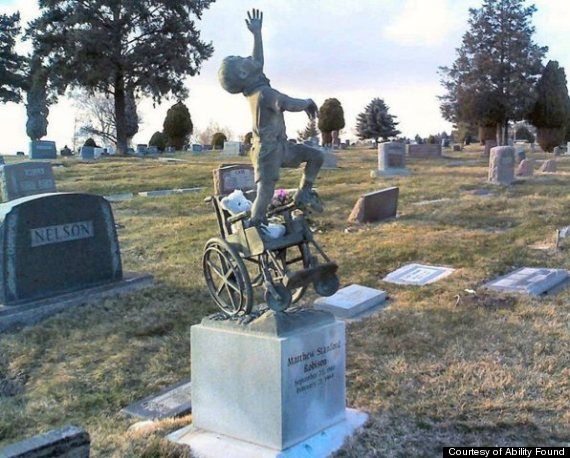
It is a statue of Matthew climbing out of his wheelchair and reaching for the sky.
One of the lessons Matthew imparted upon his parents was just how challenging it can be for people with disabilities to live as contributing members of society. It’s not for a lack of motivation, rather a lack of critical equipment.
They decided to do something about it.
In 1993, the Robisons established Ability Found, a nonprofit that gives people with disabilities the medial and rehabilitation equipment they can’t afford but need in order to do something as simple as run an errand or play outside, according to the nonprofit’s website.
The organization helps people with a range of conditions, including cerebral palsy, spina bifida, multiple sclerosis, stroke, cancer and spinal cord injuries.
In 2000, with their organization well underway, Ernest decided to honor his son in another manner — by adding the now-well-recognized statue to his son’s tombstone which is located in the Salt Lake City Cemetery.
“Instead of sadness, the statue makes our son Matthew’s grave a place of happiness,”Ernest told Enjoy Utah, a blog about sites and activities in Utah. “Many others have found that true also.”
FOR IMMEDIATE RELEASE
July 23, 2014
United Cerebral Palsy of Greater New Orleans Marks Long Comeback with Fundraising Initiative and New Website
This month, United Cerebral Palsy (UCP) of Greater New Orleans, Inc. launches its first Annual Fund Campaign since Hurricane Katrina. The fundraising initiative marks a long nine-year comeback for the 68 year-old health and human services nonprofit that was hard hit by the loss of its New Orleans headquarters and client base in the aftermath of the storm.
The organization streamlined its operations and has gradually and incrementally rebuilt its client population to where it was before the storm, according to Kendra Nelson, interim executive director of UCP Greater New Orleans. “The goal of our Annual Fund Campaign is to fill in gaps in funding for our services and to help us diversify our sources of income.”
Though Cerebral Palsy is the most common physical disability affecting children, more than 65 percent of the people served by UCP Greater New Orleans have disabilities other than Cerebral Palsy including Autism, Down Syndrome and Traumatic Brain Injuries.
Hurricane Katrina acutely impacted the most vulnerable segment of our population, the disabled. UCP Greater New Orleans, whose services support those with developmental disabilities, was one of the hardest hit and slowest to recover of the more than 400 Health and Human Services nonprofits that serve the New Orleans and Southeast Louisiana region. Among the organization’s greatest losses was its popular Children’s Program, in existence since its founding in 1946.
Over 85 percent of the children served by UCP Greater New Orleans left the area in the unprecedented evacuation during and after the storm. The Children’s Program, at the very foundation of an organization which got its start providing much needed services to children with Cerebral Palsy, was closed down. UCP Greater New Orleans’ Supported Living Services lost more than one third of its client base. The organization’s Mobile Work Crew, part of its Supported Employment Initiative, went from 47 workers to seven. Volunteers and core supporters of the organization dropped out as they worked to rebuild their own homes or moved away.
In the almost nine years since the storm, UCP Greater New Orleans has rebuilt its client base to where it was before the storm. An interim executive director has been hired, the office was consolidated as a cost-saving measure and moved to its current location in Kenner, staff and salaries were reduced, and fundraising efforts have been initiated to diversify sources of income and as a means to restore cuts to programs and services critical to the well being of the disabled community.
By managing on limited resources and being fiscally responsible, we’ve weathered a storm of far reaching and unforeseen consequences, Nelson explained. “A dedicated board of directors headed by President Steven Bain provided the leadership and determination necessary to keep this well-respected organization as a vital part of our community.”
The Annual Fund Campaign coincides with the launch of UCP Greater New Orleans’ new website. Information on programs and services that impact the daily lives of the disabled can be found on the website as well as a secure online donation page at www.ucpgno.org.
Louisiana Special Education Bill Would Segregate Students With Disabilities, Advocates Say
May 16, 2014 The Huffington Post
Should schools expect students with a disability to know the same things as other kids their age to advance and graduate?
This decades-old question, which strikes at the heart of the civil rights movement for students who have disabilities, has provoked a debate in Louisiana that’s dividing advocates.
Legislation unanimously approved by the Louisiana House now being considered by the Senate potentially would lower expectations for students with disabilities by allowing teachers and administrators to promote or graduate them without regard for state standards, according to several national advocacy groups and Louisiana’s schools chief. But local politicians and the Louisiana Developmental Disabilities Council say the bill would put Louisiana on par with other states by providing students with disabilities a clearer path to graduation.
“I’m for Louisiana having a more flexible path to a diploma for students with disabilities that are truly leading to persistent academic struggles,” John White, the state education commissioner, told The Huffington Post. “What I am not for is a bill saying students with disabilities can’t achieve traditional standards and even more than that, that we as adults shouldn’t be held accountable for helping them achieve traditional standards.”
The bill was introduced in February by Rep. John Schroder, a Republican who represents Covington, across Lake Pontchartrain from New Orleans. It was part of a flurry of legislation state lawmakers introduced to tap into rising popular sentiment against the state’s implementation of the Common Core State Standards. Schroder’s other bills would tweak the standards, but wouldn’t revoke them.
Schroder’s special education bill aims to make it easier for students with disabilities to graduate. It does so by placing promotion and graduation decisions for students with disabilities who fail to meet required scores on state tests entirely in the hands of the school-based teams that work on students’ individualized education plans, or IEPs. IEP teams could grant diplomas to students they deem incapable of meeting state and local graduation requirements, if they meet their IEP standards. The legislation would exclude those students from state tests used to judge school performance, but would reward schools for each student who meets the IEP goals.
“It’s not fine to say that our accountability of adults should be contingent on whatever we want to set that accountability at,” White said. “That sets all kinds of incentives to lower the bar and over-classify kids as having special needs.”
Critics say that has already happened in states given too much leeway.
“We know from history, in Louisiana and other states, that policies of segregation like this one result in over-identification of students to special education –- especially students of color,” the National Center for Learning Disabilities wrote Thursday in a letter to Schroder “strongly” opposing the bill. “Although students with disabilities in Louisiana continue to experience poor academic outcomes as compared to their peers and across the country, this should not induce the state to lower academic standards for these students.”
Instead, the group and others say these students need better instructional supports to help them achieve better results. Lindsay Jones, the National Center for Learning Disabilities public policy director, said in an interview that the only way for parents to make sure their kids are held to the same standards as peers would be to sue.
Also on Thursday, the Council of Parent Attorneys and Advocates wrote Schroder to oppose the bill, saying it would place Louisiana “in direct conflict with federal law and would violate the civil rights of children with disabilities.” The group said the bill “flagrantly disregards the rights of students with disabilities and disrespects their opportunity to achieve meaningful academic, social and emotional outcomes alongside their peers, through access to a regular high school diploma.”
Schroder couldn’t immediately be reached for comment.
Shawn Fleming of the Louisiana Developmental Disabilities Council said he worked with Schroder on the bill and supports it.
“This is how most kids in the nation graduate, kids with disabilities,” Fleming said. “What I find odd is why everybody else gets to do it but Louisiana.”
Fleming said letters he’s seen opposing the bill contain “misinformation,” such as the allegation that it lowers standards and violates federal law, because “federal law does not dictate how a kid graduates.”
The bill makes sense, Fleming said, because “kids should be measured based on individual progress,” and traditional academic graduation measures don’t include “nonacademic crucial things” that can count as progress for students with disabilities.
“What’s going on right now doesn’t make any sense,” Fleming said. “Kids are dropping out of school so early that we’re doing a disservice by not providing as full as an education and letting them each reach their potential as we could. That’s what this bill seeks to do.”
But Elizabeth Marcell, who oversees special education at a chain of Louisiana charter schools called Renew, said the bill is a big step back.
“There’s an assumption of good will and a failure to recognize the unintended consequences of this policy and a failure to recognize that we don’t need modified outcome standards for 90 percent of students with disabilities,” Marcell said. “It’s saying, these poor kids who aren’t able to graduate, let’s give them a diploma and make them happy, but they’re not meeting any standards. We should make sure there’s a better array of options.”
The fight in Louisiana echoes a clash in New York state, where Education Commissioner John King included in his application to extend the waiver from the No Child Left Behind Act a bid to allow up to 2 percent of the state’s students with “severe disabilities ineligible for the alternate assessment” to be tested at their instructional ability — not their chronological grade year — up to two full grade levels below a student’s current grade level. The federal government has not yet acted on King’s request.
While Fleming said he expects the Louisiana bill to clear the Senate with broad support, White said he thinks the national outcry will temper support — and create an appetite for an alternate solution. He said his office is working with politicians to create alternate assessments for students with severe disabilities without leaving standards in the hands of teachers. For example, Maryland, White said, provides project-based assessments that students can complete if they fail the state graduation test twice. Virginia has alternate courses and tests. But unlike the Schroeder proposal, White said, those states adhere to rigid standards — “they don’t just say any IEP team can make up their criteria.”
Furthermore, White said, universities likely won’t adjust their expectations, so students who attend college will be unable to succeed. “You’re setting them up for failure,” he said.
A representative from Gov. Bobby Jindal’s (R) office did not immediately return a request for comment on whether he supports the bill.
Grant to Improve Wellness, Preventive Care for Developmentally Disabled
Newswise — The University of Illinois at Chicago has received a five-year, $4.4 million federal grant to find ways to improve wellness and preventive care for adults with developmental disabilities.
The grant, from the National Institute on Disability and Rehabilitation Research, will fund a unique combination of research, training and education, and health promotion projects at UIC’s Rehabilitation Research and Training Center on Developmental Disabilities and Health.
“A lack of focus on wellness and preventive health has placed people with intellectual and developmental disabilities at greater risk for poor health,” says Tamar Heller, UIC professor of disability and human development, the principal investigator on the grant. “There are a multitude of factors that can be described as a cascade of health disparities.”
Two major health promotion projects are one component of the center’s work:
In its Health Matters program, the center developed a variety of tools to help people with developmental disabilities, including peer mentoring, online resources, and train-the-trainer programs.
“This is the only evidence-based health promotion curriculum for adults with developmental disabilities,” Heller said. The grant, she said, will fund scale-ups in three other states, which are translation of research “focused on getting best practices widely used.”
A second health promotion project, POWERS, uses technology to promote healthy behaviors, such as weight loss. This will be the first time the technology is used in the developmentally disabled population.
The center is five years into a large, long-term epidemiological study of health disparities in this population. The longitudinal study involves nearly 2,000 families that include people with intellectual and developmental disabilities.
The study is examining the relationships between health behaviors and health over a period of years — looking at the relationship between what they’re eating, their exercise, and their access and use of preventive health care — and how each of these behaviors relates to their health status over time.
“It’s a big study and the only one of its kind,” said Heller. National data sets don’t currently include such information.
“People with developmental disabilities have high obesity rates and often don’t get needed preventive care. They often develop chronic conditions earlier.
“Knowing whether some of this may be preventable could have an enormous impact on healthcare costs,” she said.
Managed care’s effect on people with disabilities is another area of research for the center, Heller said.
“States are moving Medicaid recipients into this healthcare model. The Center is developing and validating measures for quality of care for people who have cognitive limitations to help insure that this population gets needed care in the new system.”
Outreach and education at the center extends to every level, Heeler said, from peer-to-peer training, to students, to other health care professionals, and to community leaders and legislators.
“We’re interested in making a difference,” Heller said.
Learning With Disabilities:
One Effort To Shake Up The Classroom
By NPR STAFF
This is what an inclusive classroom looks like: Children with disabilities sit next to ones who’ve been deemed “gifted and talented.” The mixing is done carefully, and quietly. Students don’t necessarily know who’s working at what level.
Despite a court ruling 25 years ago that gave children with disabilities equal access to general education activities, change has been slow.
Today, about 17 percent of students with any disability spend all or most of their days segregated. Children with severe disabilities can still expect that separation.
Presidio Middle School in San Francisco has been pushing for more integrated classrooms. But even champions of an inclusive model can have difficulty balancing students’ varying needs.
Proving Grounds
At Presidio, about 10 percent of the school’s 1,200 students have special needs. That covers a broad range: from a mild learning disability to moderate and severe physical, emotional and mental disabilities.
Principal Tony Payne is in his second year at the school, and in that time he and staffers have pushed to do more to integrate special education children into the general education classrooms.
Looking at one seventh-grade math and science class, “you can’t necessarily tell me who’s the gifted kid and who’s the kid with the disability,” Payne tells NPR’s Eric Westervelt.
There are some 30 kids sitting in four rows of wooden desks. All are using old — but functioning — school-issued laptop computers. A higher-performing student sits in the middle, says teacher Grey Todd.
“She sits with kids on either side of her that might need extra help, so they can just turn to her and ask for help,” he says.
Todd “co-teaches” this math and science class with a special education teacher. Both teachers say new software and technology have greatly enhanced their ability to tailor lessons to each student and expand inclusion.
Their class is one of only a handful of mixed classrooms at Presidio, but Todd says so far, it is working and changing lives.
“We’re seeing kids that in my day would have never been in a classroom like this showing that they’re perfectly capable,” he says. He recalls one student who was very high on the autistic spectrum and had trouble communicating with people, but was one of the top-performing students academically in the whole school.
“He probably wouldn’t have had that opportunity had he been sent to a special day class,” he says. “When he’s able to be accepted … and not ostracized or sent to a separate room, I think it makes him that much more viable to himself to the community.”
Breaking It Down
But even at a school district such as San Francisco Unified, which is making an effort to expand inclusive classrooms, administrators and teachers say there are limits.
On Presidio’s ground floor, eight kids with more severe disabilities have their own classroom. It’s reserved for children with moderate to severe physical, emotional and intellectual challenges.
This segregated classroom is the traditional mainstay of special education. But even with these more challenged kids, Presidio is including them every day in gym class, art and other electives.
Presidio Middle School special education teacher Craig Holvoet says the opportunity that inclusive classrooms open up is important. But after 40 years of teaching special education, he says it’s complicated.
“I believe inclusive is fine if you want the socialization, but if you want functional living skills, or you want survival skills, then you have to break it down,” Holvoet says.
After two years of inclusive classrooms, Presidio Middle School is still trying to figure out where the limits are. Two of the kids with disabilities in Todd’s math and science class will have to move downstairs to that separate classroom next year. With math skills at the third-grade level, he says, they’re just too far behind to stay in the inclusive class.
The Opportunity Of Inclusion
Dan Habib, with the University of New Hampshire’s Institute on Disability, is an advocate for inclusion. His son Samuel, who has cerebral palsy, is 14 years old and about to go into high school. Habib says his son and their family have reaped the benefits of full inclusion.
“That inclusion in school transfers to the relationships and the support he gets from friends outside of school,” Habib says. “He’s also had a tremendous impact on his peers. His peers now see disability as part of the natural diversity of our world.”
Changing special education requires altering systems that have been in place for a long time, Habib says, systems that many teachers and administrators are familiar with. Doing so is a lot of work, he says.
“But if we know it’s going to yield better outcomes for kids with disabilities, it’s the only way to go forward,” he says.
Habib says parents are entitled to make whatever decision they feel is best for their child, but he thinks there is more opportunity for students with special needs in inclusive environments.
“I want Samuel to get a regular high school diploma, I want him to have the opportunity to go to college, I want him to have meaningful employment, I want him to have relationships; all of that is possible,” he says. “But I don’t see it being possible if he spends his whole school education on a separate track.”
Habib says as a matter of public policy every school needs to give every child access to the general education curriculum; he says they need to give kids that opportunity.
Published:: April 27, 2014
Autism More Common In Kids With
Cerebral Palsy
As the prevalence of cerebral palsy remains largely steady, new findings from researchers at the U.S. Centers for Disease Control and Prevention suggest that kids with the developmental disorder are at higher risk of having autism too.
Roughly 1 in 323 American 8-year-olds have cerebral palsy, according to findings reported this week. Of them, nearly 7 percent are also diagnosed with autism. That’s significantly higher than the 1 percent of all American kids estimated to be on the spectrum.
The figures published this week in the journal Developmental Medicine & Child Neurology come from the latest national effort to track the number of children with cerebral palsy. Such surveillance is conducted every other year much like the more commonly reported tracking of autism prevalence.
For the study, the CDC’s Autism and Developmental Disabilities Monitoring Network looked at data on 147,112 children who were age 8 in 2008. All of the kids lived near Atlanta, St. Louis, southeastern Wisconsin or in the northern and central parts of Alabama.
Cerebral palsy is more common in boys than girls and occurs more frequently in black children than in white or Hispanic kids, researchers found. Of those with the condition, more than three-quarters had spastic cerebral palsy and epilepsy occurred in about 40 percent of the kids.
Meanwhile, the study found that nearly 60 percent of children with cerebral palsy were able to walk independently and roughly 11 percent could walk using a hand-held mobility device. The remainder had limited or no walking ability.
Overall, the researchers said that the prevalence of cerebral palsy has remained “relatively constant” since 1996.
While it is unclear why kids with cerebral palsy were more likely to also have autism, the researchers said it may indicate that there are common risk factors for the two conditions.
Published October 3, 2013
Copyright © 2013 Disability Scoop, LLC. All Rights Reserved